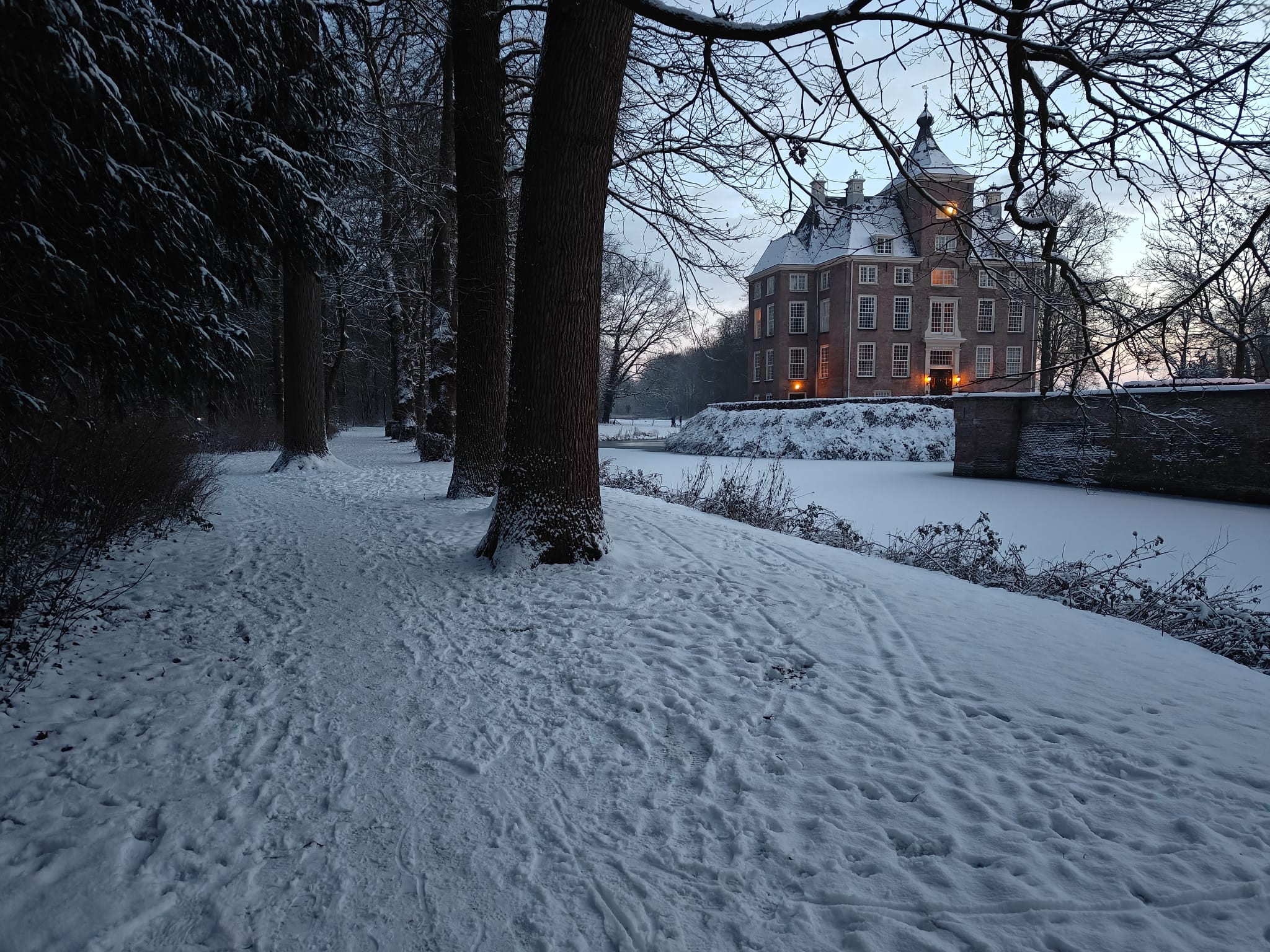
Featured photo: Pascal Smit
Last winter was widely seen as “cold” & “snowy” in the Netherlands. But that view does – despite a couple of extremely snowy days – not align with the data. It’s a clear case of shifting baseline syndrome.
A cold winter? Quite the opposite. With a mean temperature of 4.8°C, the winter of 2026 in the Netherlands was well above the long-term average of 3.9°C. And this climatological baseline, defined as the 1991-2020 mean winter temperature, itself has already warmed considerably relative to previous baselines…

Moreover, only 17 winters since the start of observations were warmer. And yet many experienced it as cold. This is where shifting baseline syndrome comes in.
Shifting Baseline Syndrome
Shifting Baseline Syndrome: “a gradual change in the accepted norms for the condition of the natural environment due to a lack of experience, memory and/or knowledge of its past condition.” (see e.g.: https://earth.org/shifting-baseline-syndrome/ & https://esajournals.onlinelibrary.wiley.com/doi/epdf/10.1002/fee.1794)
“Cold winter” perception in The Netherlands mainly due to an only slightly cold January
Granted, this winter was colder than many other winters in recent years. And the fact that it was perceived as ‘cold’ was mainly due to January. With an average temperature of 2.5°C (against an -again significantly warmed climatological norm – of 3.6°C) January 2026 was indeed on the colder side. And January also came with snowfall, which we discuss in more detail later.
Relatively cold weather and snow, a proper winter feel! A relatively cold month like that shapes the perception of the entire season.
But even January pales compared to the truly cold Januaries of the past. In fact, January 2026 didn’t even come close to the properly cold Januaries in the measurement history. The top-15 coldest Januaries all had an average temperature below 0°C. The coldest January on record, measured in 1940, saw an average temperature of -5.5°C! Unthinkable in today’s climate.

December 2025 and February 2026 in the Netherlands were mild
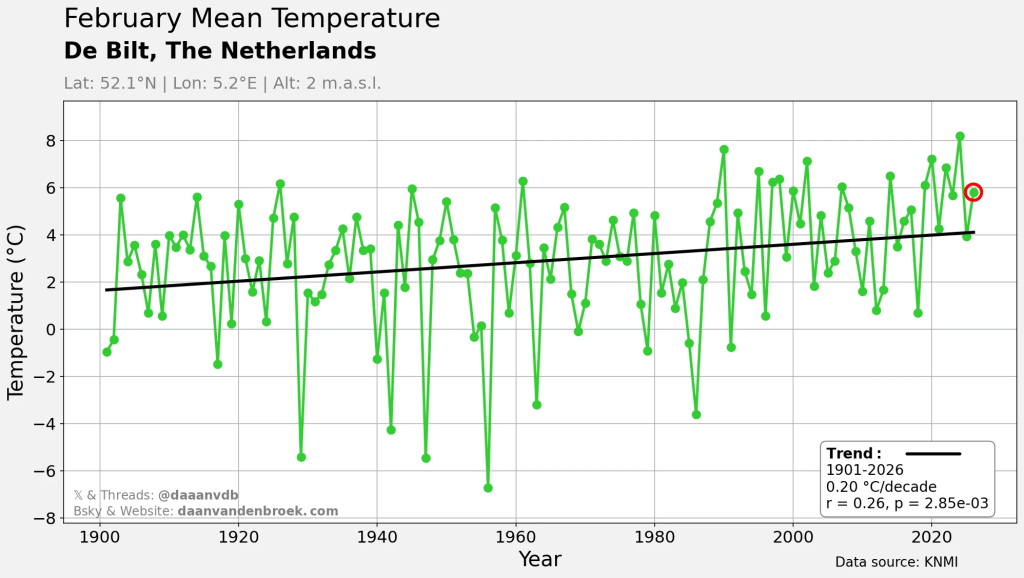
For completeness, December 2025 and February 2026 were clearly mild (as shown in the figures below). December even ranked among the top-10 warmest since observations began. After an extremely mild December, even a slightly cold January can feel unusually cold.

Exceptionally snowy conditions in the Netherlands (right?!)
But now about that snow. Because snowfall was extreme this winter, right?
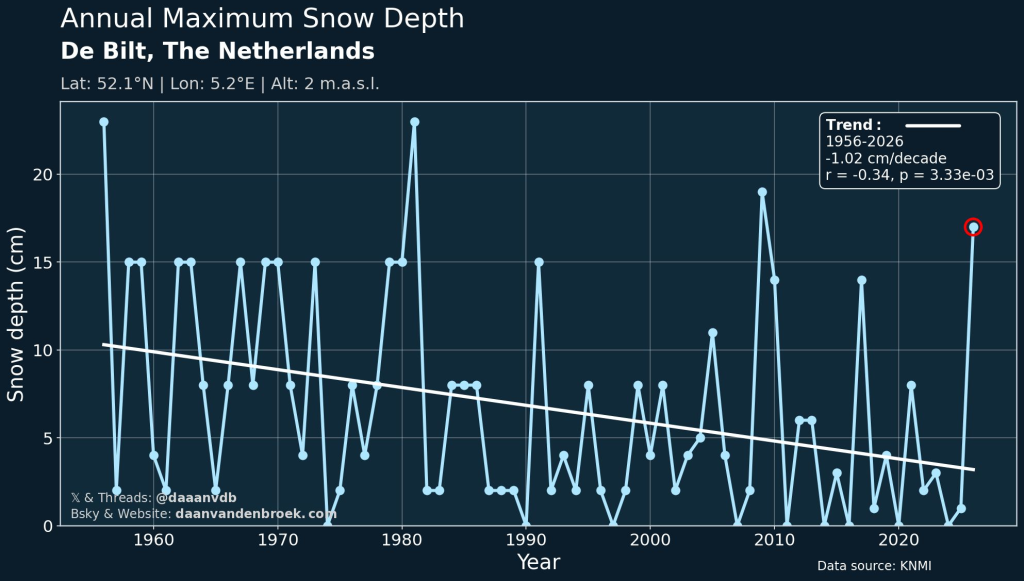
Well, in a way, yes. Especially in central parts of the Netherlands, a couple of days saw an unusually thick snow pack. De Bilt saw its 3rd deepest snowpack since records began (starting in the late 50s) The snow was rather widespread too. It lead to rather chaotic scenes in the traffic and at airports, also in the countries surrounding the Netherlands.
A nice, slightly nostalgic article about that thick snow cover by Dutch website weerverteller: https://www.weerverteller.nl/verhalen/die-monumentale-sneeuwlaag-op-de-grond.
But the snow depth only tells part of the story. Because if you look at the snow cover, the picture changes. In the past winter, de Bilt measured only 7 days with snow cover. That’s well below the average of ~11 snow-covered days before 2000.

Considering these statistics, it’s quite a stretch to call the winter of ’26 a “snowy winter”. On the other hand, the winter saw more snowy days than many other recent winters. It’s probably the combination of a thick snowpack and the fact that we’re less used to it, that caused the major disruption. That, too, shows the shifting baseline. Or, as the Guardian put it: the Netherlands has forgotten how to cope with snow.
All indicators point to a mild winter
So: a thick snow cover, one cooler month. But overall, few snow days, and a mild winter. Was there nothing else that made this winter stand out? The simple answer is no.
The number of frost days (days with minimum temperatures <0°C), ice days (days with maximum temperatures <0°C) and the hellmann cold index – a cumulative measure of winter cold based on daily mean temperatures below 0°C – all were among the lower values in the record.

Chart shows the annual number of winter days with a minimum temperature below 0°C (frost days) from about 1901 to 2026. The most recent value is highlighted with a red circle: 2026 saw only just over 30 frost days. 
Chart shows the annual number of winter days with a maximum temperature below 0°C (also termed “ice days”) from about 1901 to 2026. Values vary strongly year to year, with many winters in the early and mid-20th century having around 10–20 ice days and some peaks above 40 days, while recent decades are mostly lower, often near 0–10 days. The most recent value is highlighted with a red circle: 2026 only saw 2 so-called ice days. 
Graph of winter Hellmann cold sum (De Bilt, Netherlands) from 1901–2026. Higher values indicate colder winters. Recent winters generally have low Hellmann totals. 2026, by many perceived as a ‘cold winter’, is clearly positioned as a mild winter.
I’ve explained the Hellmann cold index in more detail here.
The mild winter of 2026 in the Netherlands: example of the shifting baseline syndrome
The data shows: the winter of 2026 was a mild one, and saw relatively few snowy days. Yet, many experienced it as ‘cold’ and ‘snowy’. That’s mainly due to the lack of frost and snow in many recent winters. And – ironically – the warmer our winter get, the more exceptional every snowy or frosty period will feel. That’s the shifting baseline syndrome.

