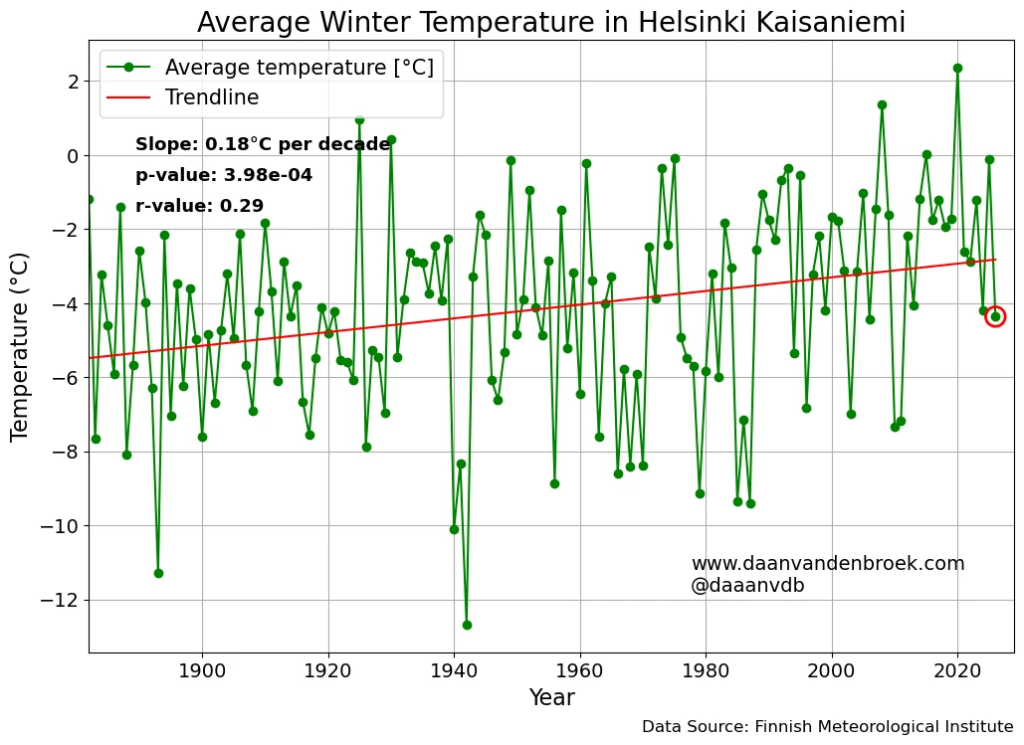
With a mean temperature of -4.4°C, the winter of 2026 was the coldest since 2010-2011 (-7.2°C). And while it was by far the coldest winter since I moved to Finland, in historical terms, this winter was far from exceptional.
Very mild December
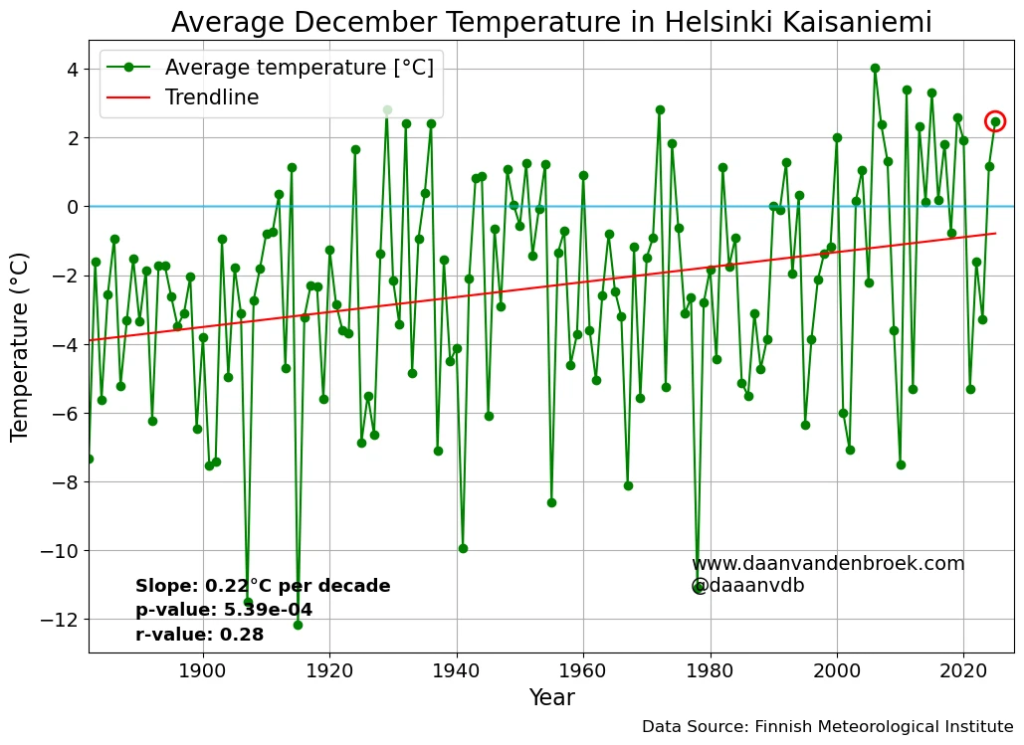
This is in a large part due to the extremely warm December. Only towards the end of the month, the first proper winter weather arrived. It started with snow-free, but frosty conditions during Christmas. A few milder days followed, after storm Hannes brought in colder air. From that moment on, the cold basically remained until the end of the winter. Still, December ended as the 7th warmest on record at an average temperature of +2.5°C.
January & February combined the 2nd coldest this century in Finland
January (-7.4°C, coldest since 2016) and February (-8.5°C, coldest since 2011) were more ‘properly cold’. In January, the temperature remained below freezing on all but 2 days, while February remained frosty until the 26th of that month.
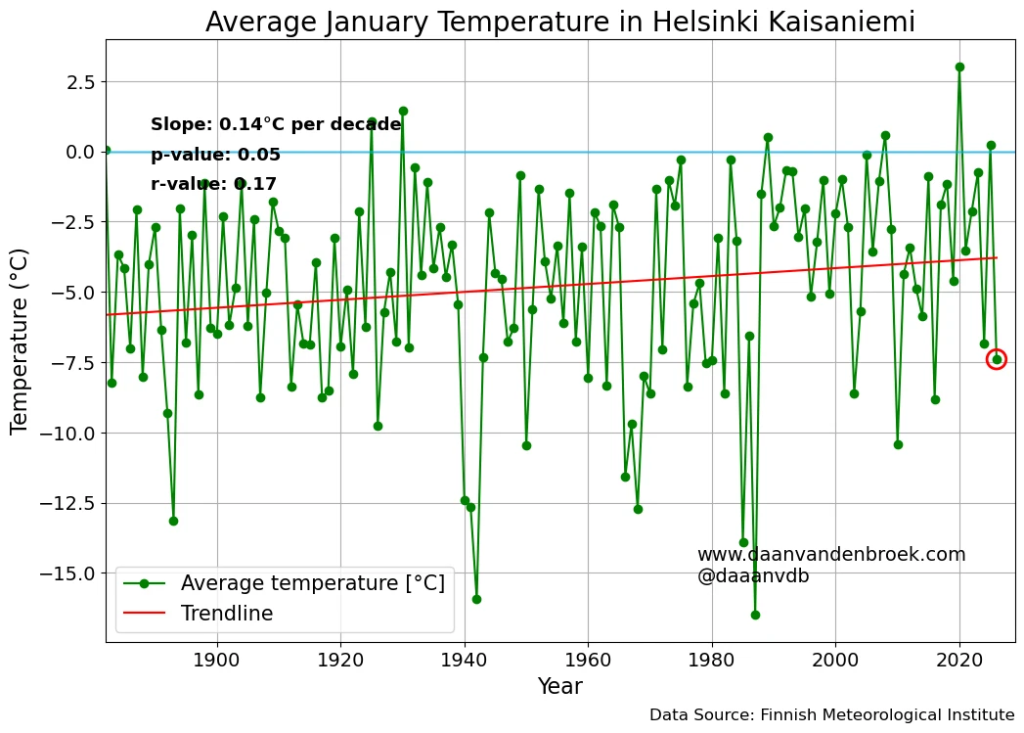
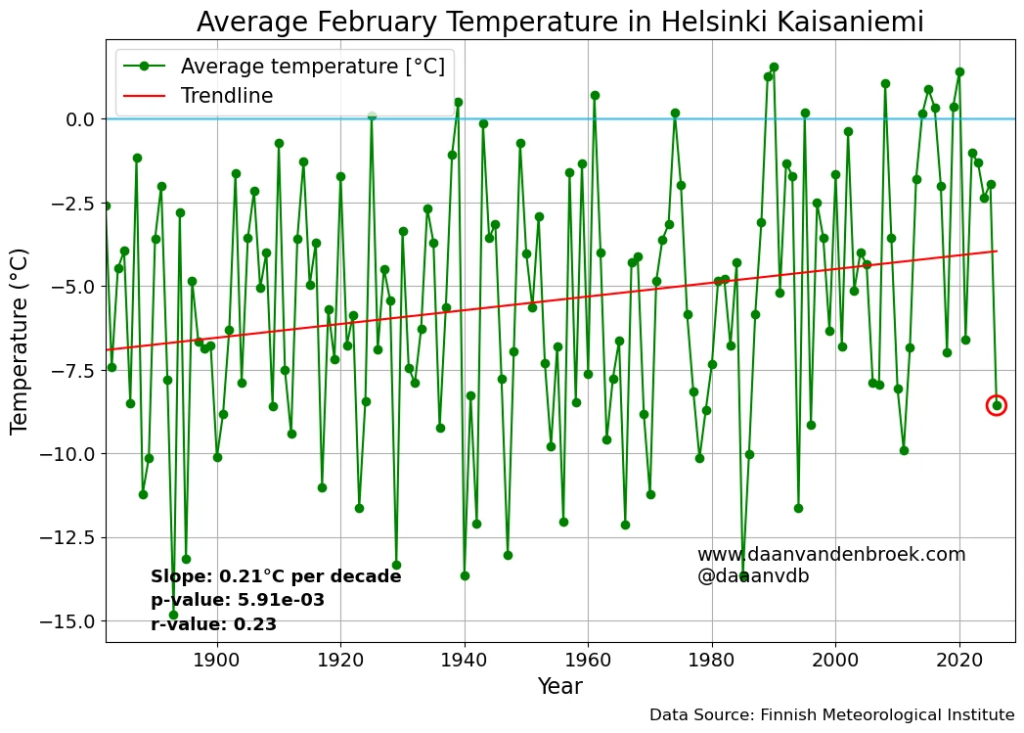
The temperature difference between Helsinki Kaisaniemi (located in the city center and close to the coast) and Helsinki-Vantaa airport (about 15 km inland) was huge: the latter measured a January average temperature of -11.9°C (coldest since January 2010). More impressive, the weather station saw 10 (!) days in January with a minimum temperature below -20°C, the most since 2003.
The rest of Finland also saw cold conditions. January and February combined were the 2nd coldest this century, narrowly below the same period in 2010:
Most sea ice in 15 years in the Baltic and Gulf of Finland
February ‘benefited’ from an almost fully frozen Gulf of Finland. The attached post shows the peak sea ice extent in late February. This helped in pulling the average February temperatures below those of January.
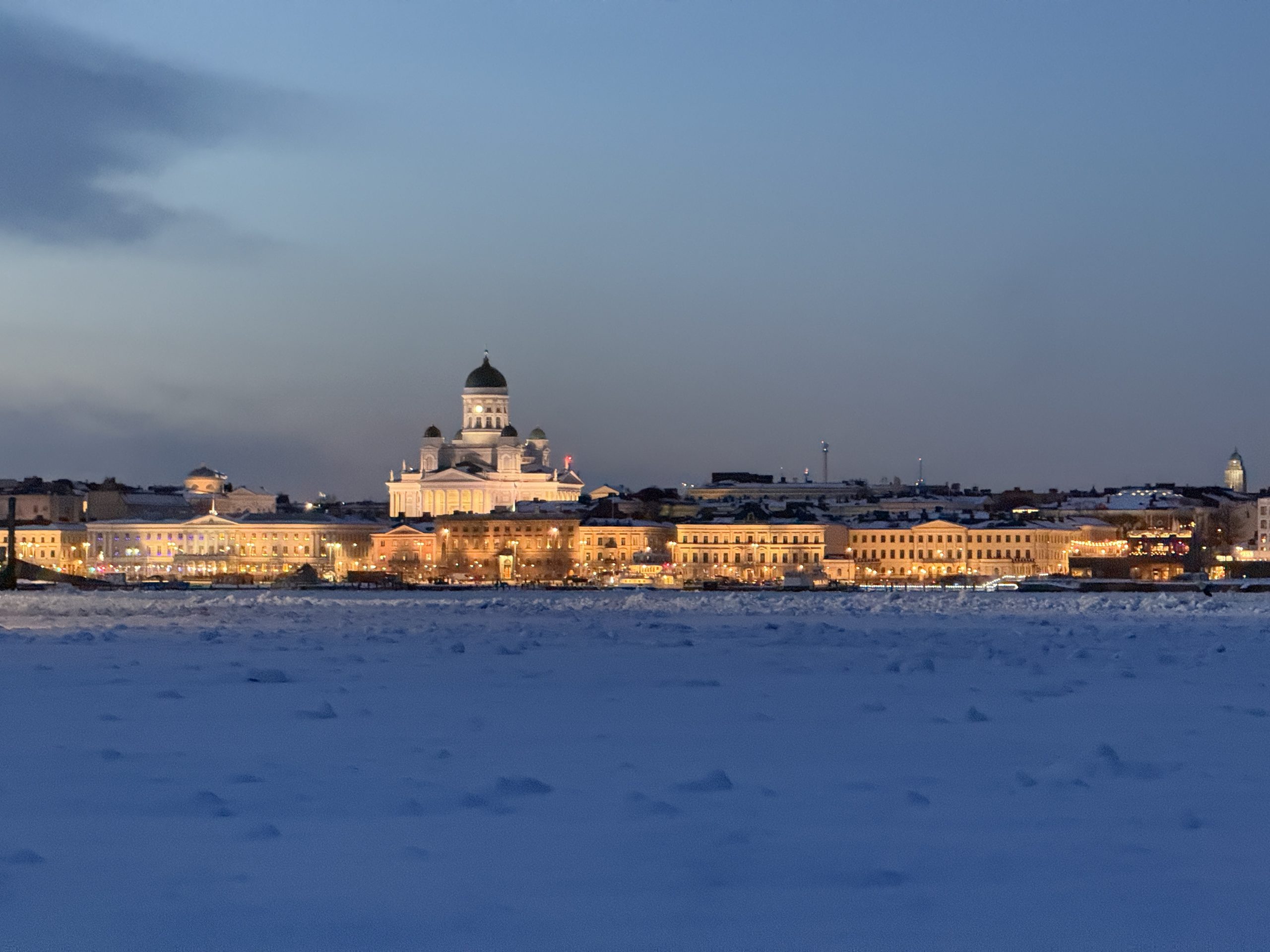
The Baltic overall also saw most ice since 2011. The sea ice went out as far as one could see from Finland’s southern coast. By far the most impressive since I moved here in 2020.
Helsinki Kaisaniemi saw 37 days consecutive ‘ice days’, i.e. days during which the temperature remain below 0°C. This was the longest continuous streak of frost since the winter of 2009-2010 (59 days). Two days narrowly above 0°C mid-January prevented an even more remarkable frost streak starting December 30th.
Extreme cold in Lapland at the start of 2026
In Lapland, the cold was particularly extreme around the change of the year. The lowest temperature was measured on January 9th, when the temperature dropped to -42.8°C in Savukoski Tulppio. Even more striking was the 2-week period from December 31st to January 13th. During those days, various stations in Lapland measured the coldest 2-week period since the extreme winter of 1987, and regionally even longer!
Extreme experience
I was lucky enough to miss exactly the majority of the very mild December, due to my research expedition to the Antarctic. I came back just before Christmas. And while the winter of 2021 was arguably more impressive because relatively cold weather was combined with a lot of snow (and the fact that it was my first winter in Helsinki, which left a strong impression), and 2022 was most impressive in terms of snow (see video below), the winter of 2026 was by far most extreme in terms of persistence of frost. Especially, how easily the temperature seemed to drop (well) below -20°C in January is something I will not forget! The fact that the temperature went above 0 only for 2 days (and only marginally so too) is also something that will stick with me. It was the first year where the sea ice went out as far as I could look in Helsinki (see the video further up in this article).